Homes with frequent outages
 Free site survey →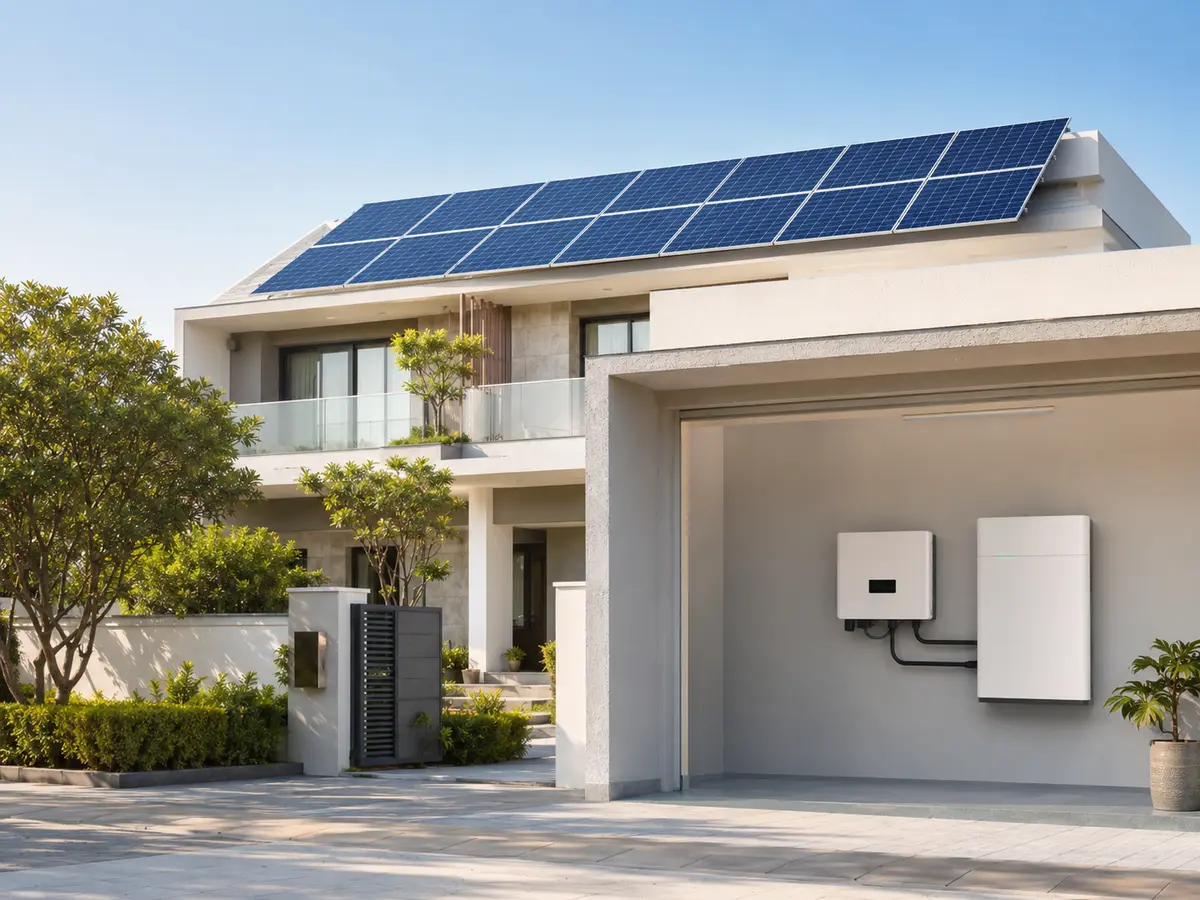
← Back to solutionsSMART SOLAR WITH BATTERY BACKUP
Hybrid Solar & Storage
Combine solar, grid and intelligent battery storage to keep essential loads running and use clean energy more flexibly.
Get a customized proposal ↗WHAT IT IS
Hybrid Solar & Storage क्या है?
A hybrid solar system integrates PV panels, a hybrid inverter, battery storage and the utility grid. It can prioritize solar for current loads, store excess energy, use the grid when required and supply selected backup loads during an outage—according to the configured energy strategy.
✓ Backup for essential loads✓ Solar energy after sunset✓ Intelligent source management✓ Expandable battery architecture
WHO IT IS FOR01 02 03 04 05
किसके लिए उपयुक्त है?
Clinics, offices and essential services
Sites using diesel generators
Remote or weak-grid properties
Customers preparing for time-of-use tariffs
मुख्य प्रकार
Grid-connected hybrid
Uses solar, battery and grid together; it provides backup while retaining grid support.
Solar + battery retrofit
Adds compatible storage to an existing system after technical and electrical assessment.
Off-grid system
Operates without a reliable utility grid and is sized around energy autonomy and worst-case conditions.
WHY CHOOSE IT01 02 03 04 05 06
मुख्य फायदे
Power continuity
Keep selected lights, fans, internet, security, refrigeration or business loads operating.
Better solar utilization
Store otherwise-exported or unused solar generation for later use.
Lower generator use
Reduce fuel, noise and maintenance by using batteries for suitable outage periods.
Smart priorities
Configure backup reserve, charging schedule and solar-first operating logic.
Modular expansion
Compatible systems can add battery capacity as future energy needs grow.
Digital visibility
Monitor solar, battery state, load and grid flow through an app or portal.
WHAT IS INCLUDED
System में क्या-क्या होता है?
Every Aisen system is engineered as a complete electrical and structural solution—not simply a set of panels.
✓High-efficiency solar modules
✓Hybrid inverter/charger
✓Lithium or suitable battery bank
✓Battery management system
✓Essential-load backup panel
✓Automatic isolation and protection
✓Smart energy meter
✓App-based monitoring and controls
AISEN EPC PROCESS01 02 03 04 05 06 07 08
Survey से commissioning तक
Outage and load-priority study
Energy consumption analysis
Solar and battery sizing
Compatibility and electrical design
Safe equipment installation
Backup-circuit segregation
Configuration and discharge testing
Handover, monitoring and support
System sizing
Battery sizing begins with the essential-load list, wattage, required backup duration, surge loads and usable depth of discharge. Solar capacity and battery capacity are related but must be calculated separately.
Investment & savings
Hybrid systems cost more than on-grid systems because of batteries, control equipment and backup distribution. The right design balances desired backup hours, battery life, future expandability and budget.
Maintenance & support
Modern lithium systems are relatively low-maintenance but require ventilation/temperature compliance, firmware and monitoring checks, safe clearances and periodic inspection of connections and protection devices.
FREQUENTLY ASKED
Common questions
Still unsure? Our engineers can assess your actual bills, site and priorities.
Backup depends on battery usable capacity and the total load running. A load schedule is needed for an accurate answer.
It is possible but often expensive. Most systems prioritize essential circuits for a practical balance of cost and backup time.
Yes, if the inverter and system architecture are battery-ready and compatible. Plan this during the initial design.
Lithium batteries are commonly preferred for efficiency, usable depth, cycle life and compact size, but final selection depends on application and budget.
A hybrid system can often be configured for grid charging, solar charging or a controlled combination depending on the equipment and strategy.
CONTACT AISEN SOLAR
Let’s plan your solar project.
Share your requirement and our engineering team will contact you for a free preliminary consultation and site survey.
CALL US+91 82859 23060WHATSAPPStart a quick chat ↗EMAILinfo@aisensolarsolutions.com
OFFICED-89, DSIIDC Industrial Area, Sector 1, Bawana, New Delhi 110039
WORKING HOURSMonday–Saturday · 9:30 AM–6:30 PM